Ten Albums, One Spaceman: A Listening Guide to Ace Frehley's Solo Records
In 1978 a guitarist from the Bronx put out a record with nothing but his own name on the cover, and it went platinum. Its single, "New York Groove", climbed into the US Top 20. Forty-six years later the same guitarist released 10,000 Volts, his tenth and final studio album. That guitarist was Ace Frehley, and the stretch between those two records is one of rock's more rewarding listening projects.
If you know Ace mainly as the Spaceman in KISS, this guide walks you through his solo catalogue era by era, so you know where to drop the needle first, and points out the designs that sit alongside each chapter.
Who was Ace Frehley, in one paragraph?
Ace was born Paul Daniel Frehley on 27 April 1951 in the Bronx, New York City. In 1973 he co-founded KISS with Paul Stanley, Gene Simmons and Peter Criss, and he played lead guitar in the band until 1982, then again from 1996 to 2002. He created the Spaceman, also known as Space Ace, out of his love of science fiction and space travel. He sang his first lead vocal on "Shock Me" from Love Gun (1977), a song inspired by a near-electrocution at a concert in Lakeland, Florida. In 2014 he went into the Rock and Roll Hall of Fame as a member of KISS. He died on 16 October 2025 in Morristown, New Jersey, aged 74. For the longer story, the Ace Frehley store has a good read on who Ace Frehley was, from the Bronx to the Hall of Fame.
Where should you start: 1978 or the Comet years?
Start where he did. Ace Frehley (1978) is the record that proved the Spaceman could carry an album alone. It went platinum, and "New York Groove", a Russ Ballard song first recorded by Hello, became his calling card.
Then come the Frehley's Comet years, three albums in three years:
- Frehley's Comet (1987)
- Second Sighting (1988)
- Trouble Walkin' (1989)
Taken together they show a guitarist building a band and a sound of his own after leaving KISS. If you like your rock straight-ahead and guitar-first, this run rewards a front-to-back listen.
On the wardrobe side, this is the era of the persona itself. The Space Ace bat youth hoodie puts SPACE ACE in yellow letters across a blue-edged black bat-wing emblem, with the Spaceman peering over the top. It is the kind of piece a younger listener who has just discovered the 1978 record will want to wear the next day.
What happened after the long gap?
Twenty years passed between Trouble Walkin' and the next studio album. When Ace came back, he came back steadily:
- Anomaly (2009)
- Space Invader (2014)
- Spaceman (2018)
The titles alone tell you he never stopped thinking about space. If you only have time for one album from this stretch, pick by title: the one that sounds most like your idea of Ace is usually the right first listen. Pair it with the Spaceman designs, such as the Signature Spaceman, with his face in frosted blue and silver and his autograph across the bottom, or the Spaceman Stencil, which cuts the star-burst make-up down to solid white contrast with blue touches in the eyes.
Why are the Origins albums worth your time?
The two Origins records are the friendliest way into Ace's playing, because you already know many of the songs.
Origins Vol. 1 (released 15 April 2016 in the US) is a covers album with a guest list that reads like a guitar magazine cover: Slash, Lita Ford, John 5, Mike McCready and Paul Stanley. It also has new recordings of KISS songs Ace wrote but did not sing on the originals. Origins Vol. 2 followed on 18 September 2020, with Lita Ford, Robin Zander, John 5 and Bruce Kulick, and its cover shows New York floating over the ocean, a deliberate link back to the first volume.
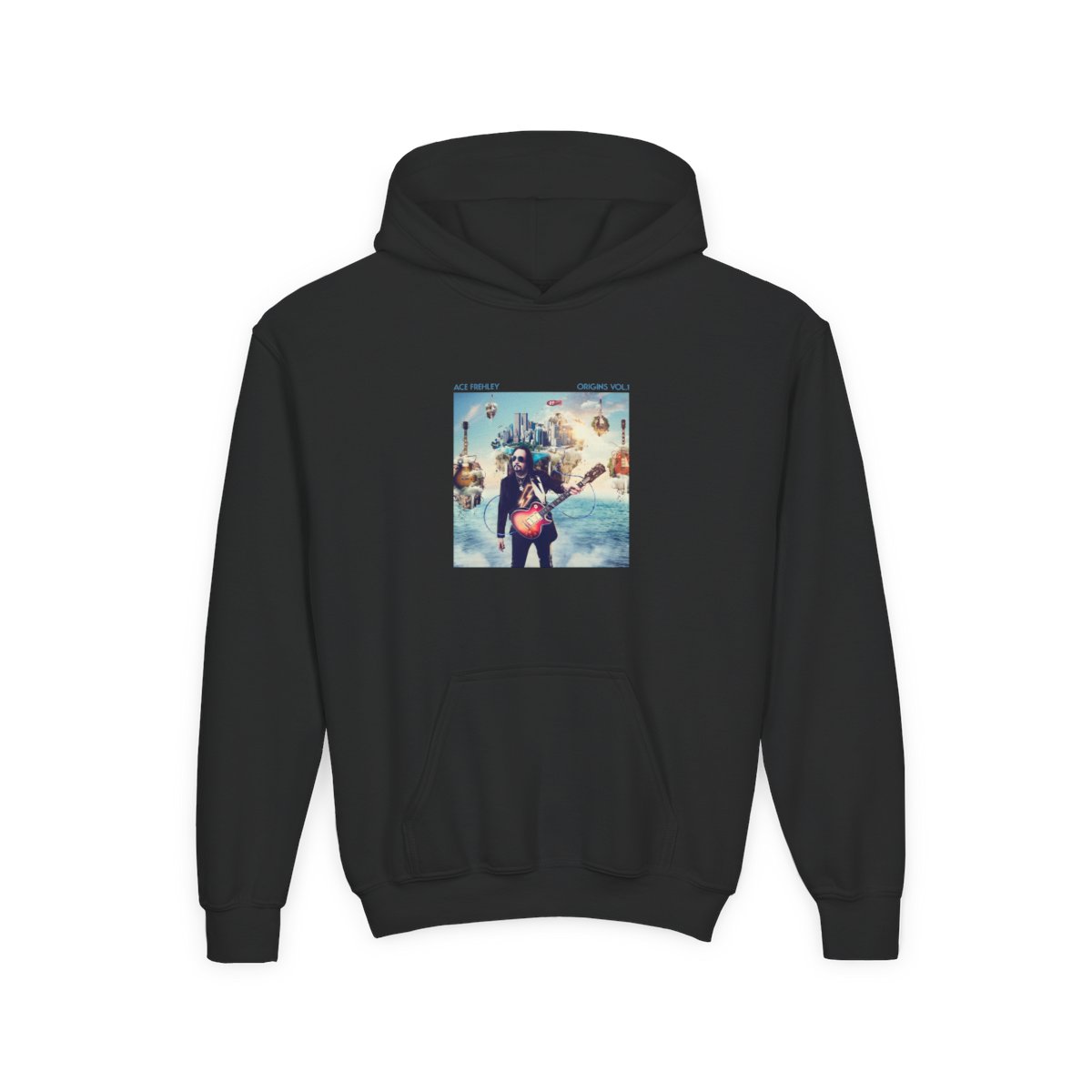
That floating-city artwork is some of the most striking in the whole catalogue. The Origins Vol. 1 youth hoodie carries the full-colour scene: Ace in the sea with a sunburst guitar beneath floating New York islands. Its night-time companion, the Origins Night City youth hoodie, shows Ace in sunglasses over a sunburst guitar, a floating island and a lightning-bolt moon. One is daylight, one is after dark; pick the mood that suits the person you have in mind.
How does 10,000 Volts close the story?
10,000 Volts came out on 23 February 2024 on MNRK. Ace produced it with Steve Brown, it reached No. 72 on the Billboard 200, and it turned out to be his tenth and final studio album. Listening to it now, after his death in October 2025, gives it extra weight: it is the last full statement from a guitarist who spent five decades chasing a sound.
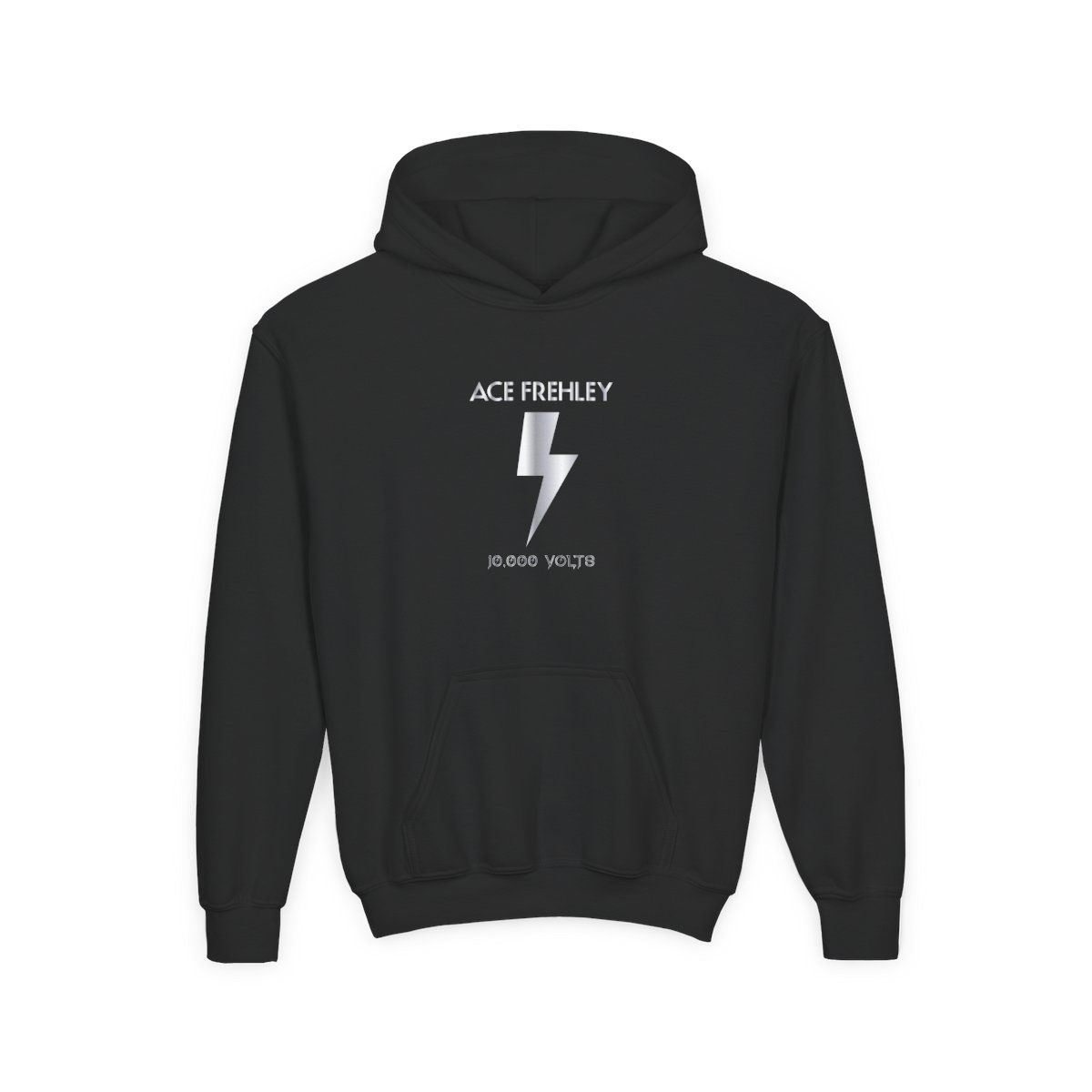
The album's look is pure lightning. The 10,000 Volts chrome youth hoodie sets a polished chrome bolt between chrome ACE FREHLEY lettering and the album title, and there is a flatter grey version of the same idea for anyone who likes things quieter. The bolt connects neatly back to "Shock Me", the song that started his life as a singer, and to the smoking guitar he made famous on stage, a Les Paul rigged to pour smoke from its pickup.
A simple listening plan
If you want to hear the whole arc without getting lost, try this order over a week of evenings:
- Ace Frehley (1978), for the start and "New York Groove".
- Frehley's Comet (1987), for the band he built after KISS.
- Origins Vol. 1 (2016), for the guests and the KISS songs he wrote.
- Origins Vol. 2 (2020), for more of the same spirit.
- 10,000 Volts (2024), for the ending.
Five records, about five decades, one Spaceman. Find the era that grabs you, and let the design from that chapter be the one you wear.